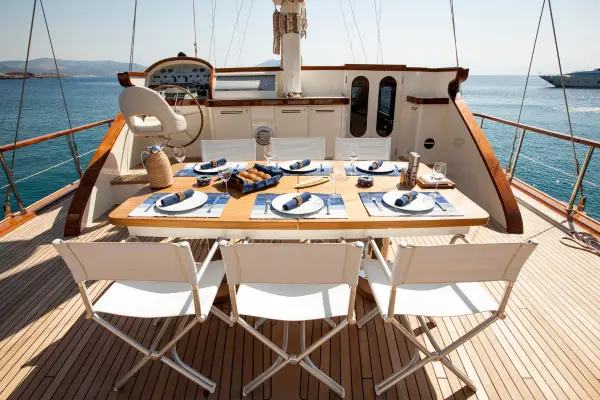
The Interior Chief yacht, also known as the Chief Stewardess or Chief Stew, is primarily responsible for the management and supervision of all activities related to the interior of the yacht. Her role ranges from coordinating the service crew, caring for guests to supervising the cleaning and maintenance of the yacht’s interior areas.
Some of its main functions would be:
1. Supervision and management of internal Affairs crew
.-Team Leadership.– Lead and coordinate the team of stewardesses and other internal service personnel.
.-Training and Development.- Train new staff and offer continuous training to maintain high standards of service.
2. Attention to the guest
.-Personalized service.-Provide a highly personalized service to ensure the satisfaction and comfort of guests.
.-Attention to Requests.-Respond efficiently to guests’ requests and special needs.
3. Cleaning and interior maintenance
.-Cleaning supervision.-Ensure cleanliness and order of all interior areas, including cabins, bathrooms, living rooms and common areas.
.-Regular inspection.– Perform regular inspections to ensure that all areas comply with quality and presentation standards.
4. Inventory and supply Management
.-Inventory Control.– Maintain and manage inventory of cleaning supplies, hygiene products, bedding, and other necessary items.
.-Ordering of Supplies.– Coordinate the procurement of supplies and maintain relations with suppliers.
5. Planning and organizing events
Planning and coordinating events and activities on board, adapting to the preferences of the guests.
.-Decoration and Preparation.- Ensure that the yacht areas are properly decorated and prepared for each event or activity.
6. Food and beverage service
.-Service coordination.– Supervise and coordinate the food and beverage service, working closely with the chef and kitchen staff.
.-Table service.– Ensure that the table service meets the standards of luxury and elegance, including the “silver service” style service if necessary.
7. Laundry management
.-Supervision of Laundry.– Supervise the laundry and ironing service for guest and crew clothes.
.-Maintenance of bedding. -Ensure that all sheets, towels and bedding are clean and well presented.
8. Communication and coordination
.-Relationship with other departments. – Work in collaboration with other yacht departments, such as kitchen, deck service, and maintenance, to ensure smooth and consistent operation.
.-Reports to the Captain.- Maintain regular communication with the captain about the state of the interior areas and any need for maintenance or repair.
9. Emergency management and security
.-Emergency procedures. – Know and follow emergency and evacuation procedures, ensuring that the indoor equipment is prepared for any situation.
.-Security of guests. – Ensure the safety and well-being of guests at all times.
10. Environmental management
.-Sustainable practices. – Implement and promote environmentally sustainable cleaning and management practices, such as the use of ecological cleaning products and proper waste management.
The head of interior of a yacht plays a crucial role in creating an experience of luxury and comfort for guests, combining management skills, organization and hospitality.
What certificates are required to work as a hostess?
There are some certificates that are necessary to work as head hostess, would be:
1.-STCW Certificate: The STCW (Standards of Training, Certification, and Watchkeeping) is a set of international regulations that sets the standards of training and competence for the maritime crew. The specific modules of the STCW would consist of:
-Techniques of Personal Survival.
-Prevention and Fire Fighting.
-Basic First Aid.
-Personal Security and Social Responsibilities.
-Awareness of Security .
It must always be obtained in authorized centers and is mandatory to work on yachts. It has a period of validity of 5 years that will have to be renewed to remain in force.
2.-Medical Certificate ENG1: This is a medical examination that ensures that the person is able to work in a maritime environment without endangering their health or that of their peers. This certificate can be obtained in authorized centers and is mandatory to work on yachts .
It also has a period of validity that must be renewed to be valid.
3.-Valid passport and visas: It is necessary to have a valid passport with at least six months validity. In addition, depending on the region where you are going to work (Mediterranean, Caribbean, etc.), it may be necessary to have specific visas such as the Schengen Visa for Europe or the B1/B2 Visa for the United States. Likewise, it is necessary to review the expiry of visas and renew them so that they are valid.
3.-Advanced English Level: A mastery of English at an advanced level (C1 or C2) is essential as most luxury yachts are operated in English. This is crucial not only for onboard communication, but also for emergency management and interaction with passengers and crew.
On the other hand.
The mastery of other languages is always well received because being in a constant multicultural environment and with crews from different countries of the world is very beneficial for good communications between them. We will analyze the most relevant ones by zone:
1. English
International language of yachting.– English is the most commonly used language in the maritime industry and in private yachts globally. It is essential to communicate with most guests and with the crew of various nationalities.
Standard for documentation and safety.- Much of the documentation and safety procedures in the maritime field are in English.
2. French
Popular in the Mediterranean.- France is a key destination in the yachting industry, especially in the French Riviera. Many clients on luxury yachts are francophone.
International yachting community.- French is also common in other key yachting regions, such as the Caribbean and parts of Africa.
3. Spanish
Wide geographical distribution.- Spanish is very useful in regions such as the Caribbean, Latin America and parts of Spain that are popular destinations for luxury yachts.
Many luxury clients come from Spanish-speaking countries, and the ability to communicate in Spanish can be a great advantage.
4. Italian
Relevance in the Mediterranean.- Italy is another important centre for luxury yachting, with popular destinations such as the Amalfi Coast and Sardinia.
Italian Maritime industry.- Italy has a strong presence in the maritime industry, and many luxury yachts are built and operated by Italians.
5. German
European customers.– Germany is a significant source of luxury tourists using yachts. Many Germans own yachts or rent luxury yachts for their holidays.
German Maritime industry.– Germany also has an important shipbuilding and yachting
6. Russian
Russian Luxury Market.- Russian customers constitute an important part of the luxury yacht market, especially in destinations such as the Mediterranean and the Caribbean.
Communication with crew.- On some yachts, part of the crew may be Russian-speaking, which makes Russian a valuable language for management and communication.
7. Chinese (Mandarin)
Emerging market.– China is an emerging market in the luxury industry, and more and more Chinese customers are interested in yachting.
Global importance.– Chinese is the world’s most spoken language, and Mandarin knowledge can be a significant asset in the global luxury industry.
8. Arabic
Middle Eastern customers.– The Persian Gulf countries are a key market for luxury yachting, with many high profile Arabic speaking customers.
Popular destinations.- Destinations such as Dubai and Abu Dhabi are important hubs for luxury yachts.
9. Portuguese
Relevance in Brazil and Portugal.– Brazil is a significant market for luxury yachting, and Portugal is a popular destination in the Atlantic.
International expansion.– The Portuguese language is also relevant in Africa and other developing regions in the yachting industry.
10. Dutch
Shipbuilding industry.- Holland is known for its luxury shipbuilding industry, and the Dutch can be useful in industrial and commercial contexts related to yachts.
Benelux customers.- Some luxury customers come from Belgium and the Netherlands, where Dutch is spoken.
Mastering these languages not only facilitates communication with a diverse clientele, but also demonstrates a commitment to service excellence and the ability to operate in an international and multicultural environment. In addition, knowledge of multiple languages is a sign of adaptability and competence.
What additional trainning is recommended?
Although there is no specific certification or university training to perform the job of Chief Stewardess if it is true that specific training in hospitality and customer service is highly valued. Having training and experience in this sector as well as cleaning and maintenance skills is highly valued. There are specific courses for Chief Stewardesses in Authorized Centers that prepare you and help you develop and perform tasks on board.
In yachts, especially large, are valued to have university degrees or certificates in Business Management, Hotel Manager, Public Relations and Advertising, Protocol and Organization of events, Marketing and Communication among others.
What skills are most valued in Chief stewardess yacht?
The most valued competencies in a Chief Stewardess are crucial to ensure the efficient operation and high quality service expected in the yacht industry. Here is a list of the most important competences:
1. Leadership and Team Management
.-Team coordination. – Ability to organize and lead a team of stewardesses, ensuring that everyone understands their roles and responsibilities.
.-Talent development. -Foster a continuous learning environment and professional development for the team.
.-Conflict resolution. – Ability to manage and resolve internal conflicts effectively and discreetly.
2. Customer Service and Hospitality
.-Excellence in customer service. – Provide a high level of service, anticipating the needs of guests and exceeding their expectations.
.-Discretion and confidentiality. – Maintain the privacy of guests and respect their personal needs and wishes.
.-Flexibility and adaptability. – Ability to adapt to changing guest needs and unforeseen
3.Technical and Practical Knowledge
.- Knowledge of etiquette and protocol. – Understand and apply the rules of etiquette and protocol in events and situations on board.
.-Management of emergency situations. – Knowledge of first aid and specific emergency procedures of the yacht.
.- Inventories and provisions management. – Ability to manage supplies, ensuring that everything necessary is available without exceeding budgets.
4. Skills of Communication
.-Clear and efficient communication. – Ability to communicate clearly with the team and guests, ensuring the effective transmission of information.
.-Multilingualism.- Knowing several languages is a significant advantage to serve an international clientele.
5. Organizational Capacity and Attention to Detail
.-Planning and organization. – Ability to plan and coordinate events and activities on board efficiently.
.-Attention to detail. – Maintain high standards of cleanliness and organization, ensuring that all areas of the yacht are in perfect condition.
6. Resilience and Ability to Work under Pressure
.-Stress management. – Ability to remain calm and work effectively in high pressure situations.
Resilience.- Be able to recover quickly from difficult situations and maintain a positive attitude.
7. Problem Solving Skills
.-Critical thinking. – Ability to evaluate situations and make quick and effective decisions.
.-Creativity in problem solving. – Finding innovative solutions for unexpected challenges that may arise.
8. Cultural Knowledge and Sensitivity
.-Cultural knowledge. – Understanding different cultures and customs, and how to interact effectively with people of different backgrounds.
.-Cultural sensitivity. – Respect and adapt services to the different cultural expectations of guests.
.9. Resource Management and Sustainability
.-Efficient management of resources. – Ability to use resources efficiently and sustainably, minimizing waste.
.-Commitment to sustainability. – Promote sustainable and environmentally friendly practices on board the yacht.
10. Knowledge of Regulations and Regulations
.-Legal and regulatory knowledge. – Understand maritime regulations and ensure that the yacht complies with all applicable laws.
.-Compliance with safety regulations. – Ensure that all safety standards are met and that the equipment is properly trained in these areas.
These competencies ensure that a head yacht hostess can provide a first-class experience to guests, effectively manage her team and keep the yacht in top condition.
If you need to hire a Chief Stewardess for your yacht contact us at info@landsearecruitment.com
Good journey!
